The First Website
The beginning of the Web as a publicly available service on the Internet arrived on August 6, 1991, when Berners-Lee published the first-ever website. Fittingly, the site was about the World Wide Web project, describing the Web and how to use it. Hosted at CERN on Berners-Lee’s NeXT computer, the site’s URL was http://info.cern.ch.
Berners-Lee didn’t try to cash in on his invention and rejected CERN’s call to patent his Web technology. He wanted the Web to be open and free so it could expand and evolve as rapidly as possible. As he later said, “Had the technology been proprietary, and in my total control, it would probably not have taken off. You can’t propose that something be a universal space and at the same time keep control of it.”
From: https://www.history.com/news/the-worlds-first-web-site
The First Web Browser
Tim Berners-Lee, who invented the World Wide Web together with Robert Cailliau, built the first working prototype in late 1990 and early 1991. That first prototype consisted of a web browser for the NeXTStep operating system. This first web browser, which was named “World Wide Web,” had a graphical user interface and would be recognizable to most people today as a web browser. However, World Wide Web did not support graphics embedded in pages when it was first released. Know more here.
From: https://www.boutell.com/newfaq/history/fbrowser.html
The First Programming Language
The first high-level programming language was Plankalkül, created by Konrad Zuse between 1942 and 1945. The first high-level language to have an associated compiler was created by Corrado Böhm in 1951, for his PhD thesis. The first commercially available language was FORTRAN (FORmula TRANslation); developed in 1956 (first manual appeared in 1956, but first developed in 1954) by a team led by John Backus at IBM.
When FORTRAN was first introduced it was treated with suspicion because of the belief that programs compiled from high-level language would be less efficient than those written directly in machine code. FORTRAN became popular because it provided a means of porting existing code to new computers, in a hardware market that was rapidly evolving; the language eventually became known for its efficiency.
From: https://en.wikipedia.org/wiki/History_of_programming_languages
The First Personal Computer
In 1975, Ed Roberts coined the term “personal computer” when he introduced the Altair8800. Although the first personal computer is considered by many to be the KENBAK-1, which was first introduced for $750 in 1971. The computer relied on a series of switches for inputting data and output data by turning on and off a series of lights.

From: https://www.computerhope.com/issues/ch000984.htm
The First Laptop or Portable Computer
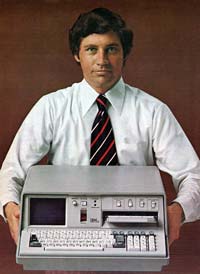 The IBM 5100 is the first portable computer, which was released in September 1975. The computer weighed 55 pounds and had a five inch CRT display, tape drive, 1.9 MHz PALM processor, and 64 KB of RAM. In the picture is an ad of the IBM 5100 taken from a November 1975 issue of Scientific American.
The first truly portable computer or laptop is considered to be the Osborne I, which was released in April 1981 and developed by Adam Osborne. The Osborne I weighed 24.5 pounds, had a 5-inch display, 64 KB of memory, two 5 1/4″ floppy drives, ran the CP/M 2.2 operating system, included a modem, and cost $1,795.
The IBM PCD (PC Division) later released the IBM portable in 1984, its first portable computer that weighed 30 pounds. Later in 1986, IBM PCD announced its first laptopcomputer, the PC Convertible, weighing 12 pounds. Finally, in 1994, IBM introduced the IBM ThinkPad 775CD, the first notebook with an integrated CD-ROM.
From: https://www.computerhope.com/issues/ch000984.htm#laptop
The First Apple Computer
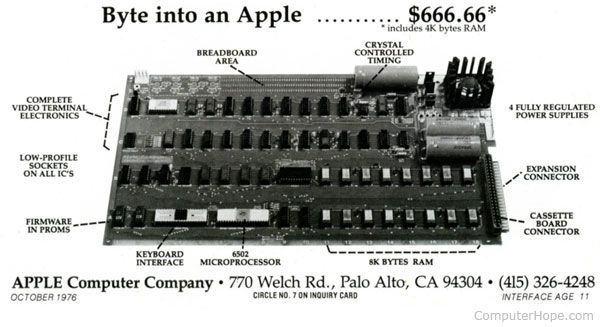
The Apple I (Apple 1) was the first Apple computer that originally sold for $666.66. The computer kit was developed by Steve Wozniak in 1976 and contained a 6502 8-bit processor and 4 kb of memory, which was expandable to 8 or 48 kb using expansion cards. Although the Apple I had a fully assembled circuit board the kit still required a power supply, display, keyboard, and case to be operational. Below is a picture of an Apple I from an advertisement by Apple.
From: https://www.computerhope.com/issues/ch000984.htm
The First Female Computer Programmer
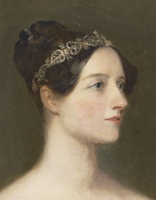
London-born Ada Lovelace (1815–1852) had a passion and gift for mathematics from a young age. She is credited with being the world’s first computer programmer, as she drafted plans for how a machine called the Analytical Engine could perform computations. The machine, invented by her friend, mathematician and inventor Charles Babbage, is considered to be the first general computer. Lovelace detailed applications for the Analytical Engine that relate to how computers are used today.
Lovelace is remembered annually on Ada Lovelace Day, held on the second Tuesday of October. The international day of recognition celebrates women in science, technology, engineering, and math (STEM).
The First Female Programmer Pioneer
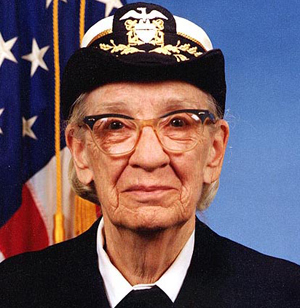
Called the Queen of Software by some and Grandma COBOL by others, Navy Rear Admiral Grace Hopper helped invent some of the early English-language programming languages. She is most famously associated with the Common Business-Oriented Language (COBOL), which was based on the FLOW-MATIC language that she designed back in 1958.
Before the invention of such language-based programming, computers spoke exclusively in binary code, which was illegible to human beings. Hopper was convinced that if programming were produced in a form that anyone could read, then there would be more programmers. It turns out that she was right.
While COBOL isn’t exactly the cutting edge of programming technology today, it still has a faithful following. In fact, in a recent Computerworld survey, 53 percent of the organizations that responded said that they were using COBOL to build new business applications.

 A New Beginning